By
By  0
0
 0
0
By Lydia’s House co-director, Mary Ellen Mitchell
Meridith helped me write a short article that was published in this month’s Plough Magazine “Friendship” edition. Noting the theme, we wrote about our journey into shared life over the last quarter century.
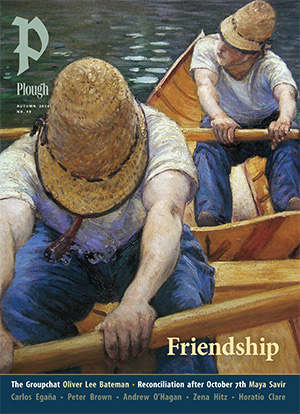
You can read the whole thing here (and in the new print copy), but this is an excerpt:
In our work with women experiencing homelessness, we see the ties of family showing up when all others have failed. If you have one person, most often a mother or a sister, who will take you in or provide childcare in a pinch, you are likely to avoid time in a shelter.
Meridith and I have become that family for each other, sisters in Christ. She will be the guardian to my children, should Ben and I not be able to care for them. Just as we’ve grown from friends to kin, we’ve also become the family of many of our guests. We have been asked to take their children into our homes, be with them during hospitalizations, and pick them up in times of crisis. The commitment we’ve made to each other has expanded beyond mutual love and care just for one another and my own children; it’s like a grain of yeast leavening the whole loaf.
Jesus told his disciples that when two or more are gathered together, He is there. I’ve wondered if he means that in the in-between space of Christian love, manifested in these deep friendships, the spirit rises—dances even. The dance is not just for our own joy, but for drawing new people in. Meridith is actually a dancer, practicing Tango every Thursday night; I definitely am not. Nonetheless, between us a crowd has gathered.

Over the past 25 years (though especially the last two weeks) Meridith and I have been together frequently. A fortnight ago, we celebrated a Mass in the shelter back yard, where Ben and I committed to walk with her for as long as God calls us to residential community at Lydia’s House. We stood in the front of a gathered group of friends and asked the congregation for support, a blessing in sharing life in this unique way.

Then last Wednesday, our shelter and aftercare community named her as our chaplain. Before she was ordained by all of us laying hands on her in prayer, she and I made a promise to care for each other and the vulnerable, in whatever way that may manifest, for the rest of our lives.

The idea of committing deeper to my life and my people has been forefront on my mind, especially since my cancer diagnosis. The calling, for me, has been to say big yes’ to real relationships and costly entanglements. This journey falls in contrast to the wave of disembodied interactions that seem to courting our collective attention.
A friend of mine Damien Stankiewicz, Ph.D. has been writing, as an Anthropologist, about relationships with machines. His basic argument is that, well, maybe they’re ok. He says
Humans assign deep value and meaning to relationships with humans they never meet: Relatives who live far away, penpals, fellow gamers they spend hours chatting with every day—how many of us have chatted with potential mates or dates on apps without ever meeting them? In a certain very real sense, they might as well be chatbots. Indeed, if after meeting someone online and flirting with them for months—sharing our thoughts with them, our dreams, our fears, our photos of burned food—we learned we could never actually meet them, would we think, “well that was totally meaningless?” No.
I’m, admittedly, very uncomfortable with never-in-person relationships, particularly with a device. One fear I have about them is that vulnerable people will get the itch of loneliness scratched while adding no one to their ecosystem of care.
Here’s what a recent article in the Atlantic had to say about this fear
The promises of chatbots are profound. They assure users of a companion that is always available, always supportive, and never judgmental. No human can offer that. This is what makes chatbots so pernicious
While well off people might be able to meet all their physical needs with money or hired help— friends and lovers being a kind of window dressing to make life more fun or meaningful, I know from experience that is not the case for the struggling (or for me for that matter).
What I want to ask of those that are working quickly to make the computer’s voice more human is, “Can a bot help you move?” (That may just be on my mind this week because I’ve been moving for what seems like the last 100 days.)
Some other questions I have about AI relationships: “Can a bot watch your kids so you can go to work?” “Will they bring you food and clean your house after you have a baby?” “Will they help you when you’re short on rent?” I know these computer generated people are supposed to be amazing, but I’m also willing to say no they can’t or won’t do any of the aforementioned caregiving.
On this topic, Pope Leo wrote
The quality of a civilization is measured by the care it is able to offer, by its ability to recognize the other as a face not merely as a function. The ability to care for one another is a fundamental dimension of our humanity, one that is learned and mastered through lived experience. Reading stories to a child, offering company to an elderly person and arranging a home so that it is welcoming are simple gestures often rooted in family life. They teach us to value care at a societal level and train us to recognize others as persons worthy of attention
My attention to the value of ecosystems of care is always being fine tuned through the lens of our guests at Lydia’s House, since they are in particular crisis. It’s also been honed through my last year of managing an unexpected illness. But the muscles were forming long before, when my mom was dying of leukemia, when I had two babies and we were starting the shelter, when I broke my leg during my third pregnancy.
I often joke about the number of times when, left without my circle of help, I would have been eaten by wolves. Will a bot fight the wolves? No. But my people have again and again.
Which brings me back to Meridith, and to the commitments we’ve made to one another. This moment in history offers all of us ever more ways to experience connection without obligation; in contrast she and I have chosen the opposite— to become indefinitely obligated. We have given and will give each other time, money, houses, inconvenient needs, the care of children, an entire compound of buildings and the shared care of staff and crises that come with having started an organization that serves homeless families. The promise going forward, and really established many years back, is good times and bad all the days of our lives.


Is it ok to go down rabbit holes of disembodied distraction, chatting with a fiction character or wondering what the Ballerina Farm is up to? I guess so. But time and energy has opportunity cost. The cost of time spent on things that are fake could go to people who are real, toward engaging the friction of humanity that rubs off our hard edges, toward supporting others in their moments of need in hopes that they’ll support us in ours, toward committing to long term, complicated partners and friends for the sake of building a beloved community that Jesus called “The Kingdom of God.”
I’ll finish with a favorite Wendell Barry passage of mine— this one highlighting a more common, inextricable promise (typically one that works best in person): marriage. Wendell died last week and I’ll venture to guess he was ready to move on from this world once the word “AI companion” became standard vernacular.
Lovers must not, like usurers, live for themselves alone. They must finally turn from their gaze at one another back toward the community. If they had only themselves to consider, lovers would not need to marry, but they must think of others and of other things. They say their vows to the community as much as to one another, and the community gathers around them to hear and to wish them well, on their behalf and its own. It gathers around them because it understands how necessary, how joyful, and how fearful this joining is. These lovers, pledging themselves to one another “until death,” are giving themselves away, and they are joined by this as no law or contract could join them. Lovers, then, “die” into their union with one another as a soul “dies” into its union with God. And so here, at the very heart of community life, we find not something to sell as in the public market but this momentous giving.
From the essay “Sex, Economy, Freedom and Community”